Two main traditions
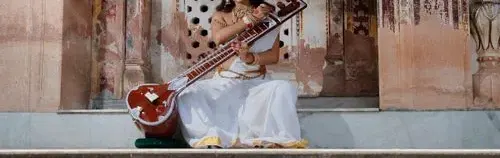
Indian classical music has two main traditions. Both are rich, disciplined and based on improvisation within a set framework.
- Hindustani music is the classical music of North India. It includes forms such as khayal, and devotional forms such as bhajan. Hindustani singers work closely with a drone and a harmonium or other accompaniment.
- Carnatic music is the classical music of South India. Students often learn a set of graded exercises and compositions, including varnam, kriti and swara kalpana.
Your choice depends on your interest, your background and the style of music you want to sing or play.

Key ideas you will meet
- Raga is a framework of notes, with rules for how they are approached and ornamented. It is more than a scale.
- Tala is the rhythmic cycle. It organises beats into repeating patterns.
- Sa and the other swaras (notes) are the foundation for singing and practice. Sargam exercises train you to sing them accurately.
- Riyaaz is the daily practice that builds technique, pitch and memory over years.
Why online lessons work
Many students in Australia study Indian classical music online. Online lessons can work well because:
- Your teacher sees and hears you clearly on camera, including breath, posture and pitch.
- You can use a drone (a tanpura or a steady reference tone) from a device or recording, so you can practise in tune without a live accompanist.
- Lesson times can fit your schedule, in your local Australian time zone.
Good audio matters. Use a headset or a good microphone, and choose a quiet room with soft furnishings to reduce echo.
What a beginner practises
A typical first few months might include:
- Breathing and posture, sitting upright and relaxed.
- Sa and the drone, singing the tonic steadily against the drone.
- Sargam, sung slowly and accurately up and down the scale.
- Simple taal cycles, clapped and counted before you sing to them.
- A short bandish or composition in a raga your teacher chooses.
Practise for 20 to 30 minutes a day. Keep your voice warm, and stop if you feel strain.
Voice care
Singing classical music asks a lot of the voice. Avoid shouting, drink water, rest when you are tired, and warm up gently before you practise. If you feel pain or hoarseness, speak to a doctor.
What we teach
Dr Banerjee teaches Indian classical vocal, Hindustani vocal, Carnatic vocal, harmonium, Indian flute (bansuri) and devotional and regional songs, all one-to-one and online. The about page explains the teaching approach. Each lesson is taught personally.
Hindustani and Carnatic: related, distinct traditions
Both traditions develop careful listening, pitch awareness, rhythmic control and repertoire, but their systems, terminology and performance practices are not interchangeable. Hindustani study commonly explores raga and tala through forms such as khayal; Carnatic study has its own raga framework, tala practice and repertoire including kriti and varnam. These are broad entry points, not exhaustive definitions. A student should choose the tradition that connects with their interest and teacher’s expertise rather than trying to merge two different learning paths at the start.
What an early lesson can focus on
A beginner might begin with posture and breath for singing, a comfortable pitch range, careful listening, and short pitch or rhythm exercises. A more experienced learner may work on a selected composition, pronunciation, phrasing, ornamentation or rhythmic detail. The teacher should explain the purpose of an exercise and how it connects to the music, instead of treating repetition as a goal by itself. If the learner already knows songs from family or community settings, those can help start a conversation about style and repertoire.
Build an online practice setup
Use headphones only if they let the student hear their own voice clearly; excessive monitoring can make pitch harder to judge. Position the camera so the teacher can see posture and breathing, and reduce background noise. Keep a notebook of the phrase or exercise practised, the starting pitch where relevant, and one question to ask next time. Record practice only with the student’s consent and for private learning, not for sharing without permission.
Next steps
- Book a free demo to tell me which tradition interests you.
- Read about harmonium for beginners, which is often part of Indian classical training.
- See fees and plans.